Stop the Fail-Open Glitch Before You Lose Your Inventory
Active Defense Against 2.4GHz Jammers and MDB Jackpotting
The Problem: The "Fail-Open" Exploit
In 2026, the greatest threat to your automated retail business isn't a crowbar; it’s a $20 handheld RF jammer. Modern vending machines are designed for "convenience," which means if the wireless signal is weak, the machine enters a "Store and Forward" or "Fail-Open" state.Hackers now exploit this by flooding the machine with 2.4GHz interference at the exact moment of purchase. This tricks the payment terminal into approving a transaction offline without a bank authorization. By the time your machine reconnects to the network, the "transaction" is revealed as a spoofed card or a dead account. The thief walks away with your highest-value inventory, and you are left with a "communication error" log and zero revenue.The Solution: Vending Guardian™
Vending Guardian is a proactive, hardware-based interceptor that sits directly on your machine’s Multi-Drop Bus (MDB). Unlike a camera that only records the loss, our device is an active gatekeeper.It monitors the local radio spectrum for the signature "noise floor" spikes of a jamming attack. If the Guardian detects wireless interference while a transaction is in progress, it instantly sends an "Inhibit" command to the bill validator and card reader. It kills the transaction before the "Fail-Open" glitch can trigger. No signal, no dispense. Your inventory stays behind the glass.The ROI: Instant Payback
Security shouldn't be an expense; it’s a recovery strategy. In a high-end electronics kiosk or a busy transit hub, a single "Jackpotting" session can cost you thousands in inventory in under ten minutes. One prevented theft of a high-value item—or a single thwarted "bulk-buy" attack—pays for the Guardian hardware and a full year of monitoring. ---
Designed for vending machines, smart lockers, self checkouts, automated kiosks
94% of Global Fleets are Vulnerable: In 2026, research shows that almost any machine using the MDB 4.2 standard (which is nearly all of them) has no way to verify if a "VEND" command was forged.The "Wireless Explosion": Wireless CVEs (Critical Vulnerabilities) are growing 20 times faster than standard computer bugs. In 2025 alone, 937 new wireless exploits were discovered that specifically target IoT chipsets used in vending.Average Detection Time: It takes an operator an average of 22 days to realize a machine was "jackpotted" because the inventory loss is often blamed on "accounting errors" or "malfunctions."
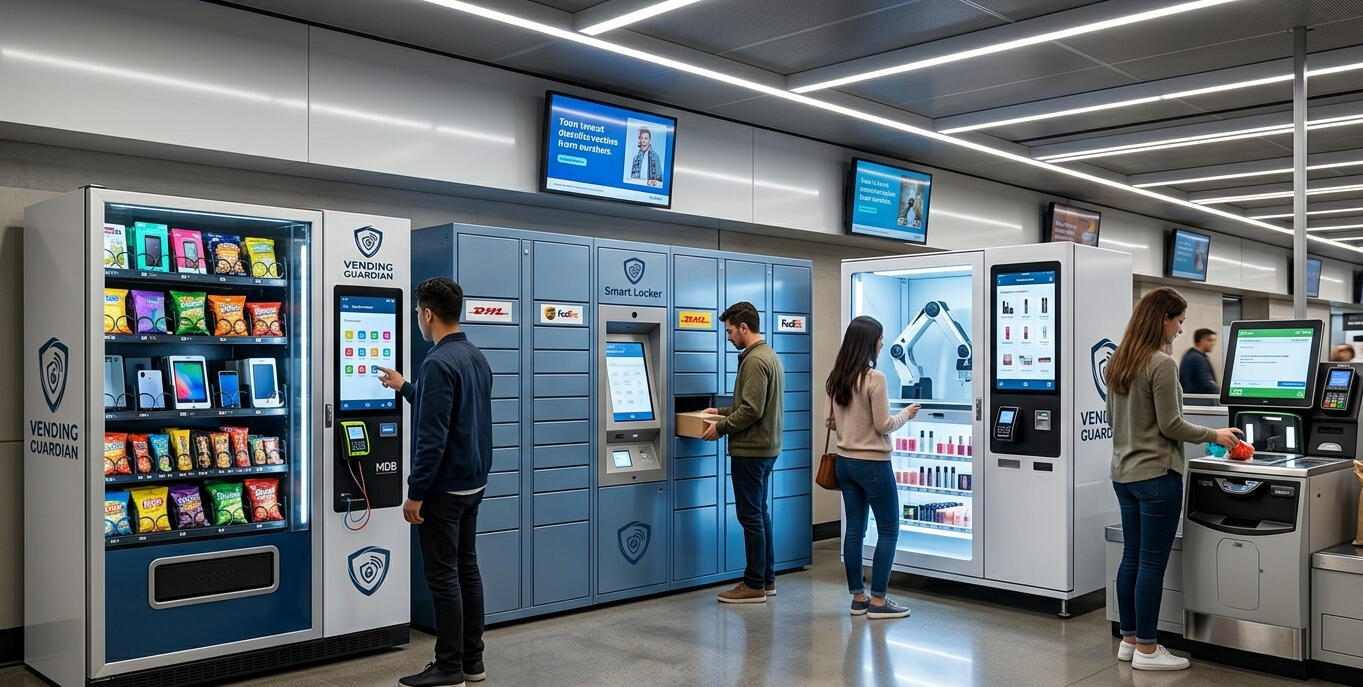
We provide a tailored 1994-standard Molex harness that sits between your bill validator and your mainboard. It’s like adding a smart translator. Your machine works exactly the same, but now it has an intelligent gatekeeper monitoring the airwaves and the data flow
Targeted brands :
Crane Payment Innovations (CPI)
Crane Merchandising Systems
Dixie Narco
Automatic Products (AP)
Royal Vendors
VNE
Vendo
SandenVendo
GPL (Glass Plus)
Wittern Group
USI (United Select Food)
AMS (Automated Merchandising Systems)
Fastcorp Vending
Seaga Manufacturing
Sielaff
Azkoyen
Signifi
DigitalGo
Swyft Store
ZoomSystems
Jofemar
Necta
Wurlitzer
Polyvend
Cavalier
Selectivend
Fuji Electric
Bianchi Vending
Invenda
Nayax
Cantaloupe
USA Technologies
Byte Technology
Farmer’s Fridge
Automated Retail Threats in 2026
Cashless Fraud: The SDR & Spoofing EraThe shift to 100% cashless vending has created a playground for tech-savvy criminals. In 2026, we are seeing a massive surge in Software Defined Radio (SDR) attacks. Criminals use devices like the Flipper Zero or specialized ESP-based boards to emulate high-level MDB commands. By "sniffing" the wireless communication between your machine and the cloud, hackers can inject a "Successful Payment" signal directly into the machine's brain, forcing a dispense without a card ever being charged. Standard telemetry units are blind to these "Ghost Transactions" because they happen at the hardware level, bypassing the payment processor entirely.BLE Proximity Spoofing: Many modern machines use Bluetooth Low Energy (BLE) for "loyalty apps" or maintenance. Hackers use a "Link Layer Relay" attack (confirmed in 2026 by groups like NCC) to trick the machine into thinking an authorized phone is standing right in front of it, even if the real owner is 10 miles away.The "Beacon" Hijack: Criminals place a tiny $5 BLE beacon near the machine. When an operator or a customer with a payment app walks by, the beacon "intercepts" the handshake and clones the session ID.WPA3-SAE "De-auth" Loops: For machines on Wi-Fi, hackers use "De-authentication" packets. This forces the machine to drop its secure connection and attempt a "Fallback" to an unencrypted or "offline" state—re-opening the door for the Fail-Open Jamming exploit.The Return of Cash Theft: Logic Over LeverageWhile physical "smash and grabs" are still a nuisance, the real threat to cash-heavy machines is now Logical Jackpotting. Modern thieves have realized that the bill validator is a computer that speaks a specific language. By accessing the machine's external service port or using a "Shimmer" inside the bill slot, attackers can send a signal that tells the coin mech to dispense its entire hopper of change or tells the bill stacker that it has received a $100 bill when only a $1 was inserted. These "MDB-Injection" attacks allow criminals to empty a machine's cash reserves in seconds without leaving a single mark on the cabinet, making it nearly impossible to prove theft to insurance companies without specialized forensic logging.
Provide your insurer with the wireless proof
Contact
To add wireless monitoring to your security stack